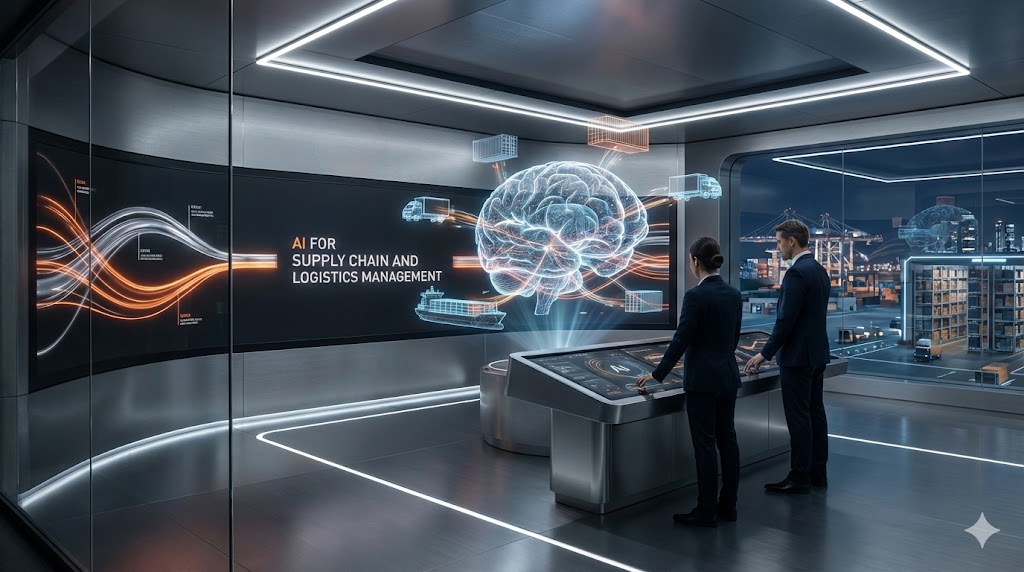
Elite AI for Supply Chain and Logistics Management: Incredible Route to Massive Global Efficiency and Profit
Introduction: The Pulse of Global Commerce in 2026
In the hyper-connected and volatile global economy of 2026, the implementation of AI for Supply Chain and Logistics Management has officially transitioned from a competitive advantage to a mandatory survival mechanism. For decades, the movement of goods across borders was defined by a fundamentally “fragile” model: manual inventory tracking, reactive responses to port delays, and a reliance on human intuition to predict complex consumer demand. Logistics managers and supply chain directors often found themselves trapped in a state of perpetual “firefighting,” spending more than 80% of their time resolving avoidable bottlenecks rather than focusing on the strategic growth that builds legendary market dominance.
However, a revolutionary “route” has emerged. At AIBizRoute, we see AI for Supply Chain and Logistics Management as the ultimate “Grand Orchestrator” of physical goods. Today, an elite logistics operation is no longer judged solely by its fleet size, but by the intelligence of its automated systems to anticipate disruptions, optimize fuel consumption in real-time, and provide an “Incredible” level of predictability at scale. This massive guide will explore how AI for Supply Chain and Logistics Management is creating an incredible, automated, and powerful route for businesses that want to achieve massive growth while redefining the standards of global operational excellence.
The Logistics Crisis: Why Manual Flow is Obsolete
In 2026, a delay of just four hours in a delivery chain can trigger a massive financial ripple effect across an entire continent. If your supply chain business is still relying on manual spreadsheets, human-led route planning, and reactive inventory replenishment, you are operating with a massive structural disadvantage. Human error in logistics—such as an overstocked warehouse or a miscalculated shipping route—doesn’t just lead to an extra expense; it leads to a total collapse of client trust and a decline in your elite brand value.
When you implement AI for Supply Chain and Logistics Management, you are deploying a “digital navigator” that monitors millions of global variables 24/7. Unlike a human dispatcher who might struggle to account for sudden weather shifts in the Atlantic while managing truck driver fatigue in Europe, AI for Supply Chain and Logistics Management maintains absolute precision across the entire journey. This transition from manual to automated is about moving from “moving boxes” to “managing intelligence,” providing an incredible competitive edge.
Route 1: Incredible Predictive Demand Forecasting and Inventory Optimization
The first and most profit-intensive pillar of AI for Supply Chain and Logistics Management is the total elimination of “dead stock.”
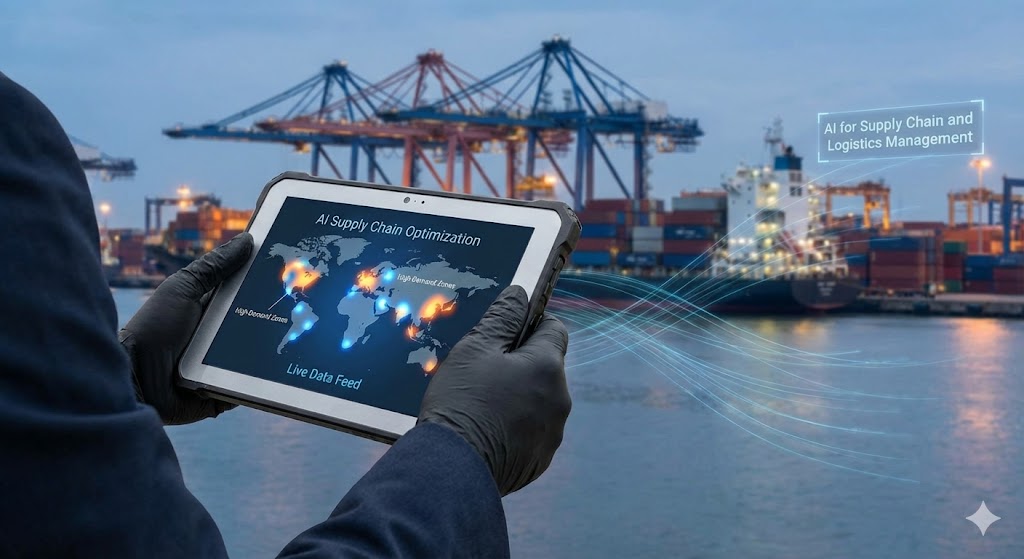
- Advanced Demand Sensing: AI for Supply Chain and Logistics Management analyzes social trends, weather patterns, and global economic signals to predict consumer demand with “Incredible” precision before an order is even placed.
- Automated Inventory Balancing: The AI automatically shifts stock between regional warehouses to ensure that high-demand products are always in the “Powerful” location, reducing shipping times and costs.
- Internal Link Synergy: To manage the production cycles that feed this inventory, explore our guide on AI in Manufacturing for Small Business.
- Outbound Link Otoritas: Discover the latest in global logistics standards at the Council of Supply Chain Management Professionals (CSCMP) or APICS/ASCM.
Route 2: Powerful Autonomous Warehousing and Computer Vision
The “middle” of the logistics route—the warehouse—is where AI for Supply Chain and Logistics Management delivers its most visual impact.
- Autonomous Robotics Integration: AI orchestrates swarms of robots that navigate complex warehouse floors with surgical precision, picking and packing orders 5x faster than human-only teams.
- Computer Vision for Quality Control: AI for Supply Chain and Logistics Management uses high-speed cameras to inspect every package for damage or incorrect labeling in milliseconds, ensuring that only “Legendary” quality goods leave the facility.
- Smart Space Optimization: AI constantly re-calculates the most efficient warehouse layout based on current item velocity, placing high-turnover goods nearest to the loading docks.
- Internal Link Synergy: To manage the physical infrastructure where these automated warehouses reside, see our guide on AI for Property Management Software.
Route 3: Seamless Last-Mile Logistics and Dynamic Route Optimization
The final leg of the route is where AI for Supply Chain and Logistics Management creates its most “Massive” customer satisfaction gains.
- Dynamic Real-time Routing: AI analyzes live traffic, vehicle health, and delivery windows to re-route drivers on the fly, saving thousands of “Powerful” hours and reducing fuel emissions by up to 30%.
- Predictive Vehicle Maintenance: AI for Supply Chain and Logistics Management identifies when a delivery truck is likely to fail before a breakdown occurs, automatically scheduling maintenance during off-peak hours to ensure zero downtime.
- Internal Link Synergy: To manage the workforce driving this logistical machine, integrate our AI for Recruitment and Hiring strategies.
The Financial Impact: Scaling to Elite Logistical Power
Supply chain owners often worry about the “high-tech” overhead. However, AI for Supply Chain and Logistics Management actually creates massive new profit margins:
- Reduction in Storage Costs: Precise AI forecasting allows for a “Just-in-Time” model that can reduce warehouse footprint costs by up to 40%.
- Increased Sales Velocity: Faster, automated delivery routes lead to “Incredible” customer loyalty and higher repeat purchase rates.
- Elite Environmental Efficiency: Reducing fuel waste and carbon footprints allows your brand to capture “Massive” value in the sustainable-conscious market of 2026.
A 30-Day Blueprint for Supply Chain Automation
To achieve an Incredible operational gain, follow this structured four-week route:
Week 1: Data Connectivity and IoT Audit Evaluate your current ERP and sensor network. Implement a central AI “brain” that can ingest real-time data from every point of your supply chain.
Week 2: Pilot Predictive Forecasting Apply AI demand sensing to your top 3 product lines. Monitor the “Powerful” reduction in stockouts and overstock errors within the first 7 days.
Week 3: Warehouse and Last-Mile Triage Launch Enable AI route optimization for your delivery fleet. Use AI for Supply Chain and Logistics Management to handle the repetitive administrative “handlers” work of scheduling and dispatch.
Week 4: Scaling and Global Synergy Expand the strategy to your entire international network. Integrate it with your AI Financial Forecasting to ensure your logistical expansion is backed by massive, predictive data.
Conclusion: The Future of the Visionary Logistics Leader
The implementation of AI for Supply Chain and Logistics Management is the final step in turning a local distribution business into a massive, resilient, and elite global empire. By automating the handlers’ work of admin, search, and logistical coordination, you free yourself to be the strategic architect and master of flow your clients desperately need in 2026.
While other companies are still struggling with manual spreadsheets and slow deliveries, you will be operating an incredible, powerful, and seamless supply chain machine. The route to legendary efficiency is now automated. We invite you to explore our About Us page to learn more about our mission. For a broader look at business-wide strategy, don’t miss our AI Automation for Small Business guide.