AI in Manufacturing for Small Business: Incredible and Powerful Route to Massive Production
Introduction: The Industrial Renaissance of 2026
In the hyper-competitive global market of 2026, the implementation of AI in Manufacturing for Small Business has officially leveled the playing field between local boutique workshops and massive international conglomerates. For over a century, the manufacturing sector was defined by “economies of scale”—the idea that only the largest companies with the most expensive machinery could achieve high efficiency and low costs. Small manufacturers were often relegated to low-margin niche work, struggling to compete with the sheer volume and precision of industrial giants.
However, a revolutionary “route” has emerged. At AIBizRoute, we view AI in Manufacturing for Small Business as the ultimate intelligence multiplier. Today, an elite small-scale factory is no longer defined by the square footage of its floor, but by the sophistication of its data-driven operations. This massive guide will explore how AI in Manufacturing for Small Business is creating an incredible, automated, and powerful engine for manufacturers who want to achieve massive production quality while remaining agile and profitable.
The Production Crisis: Why Manual Factories are Obsolete
In 2026, the cost of raw materials, energy, and skilled labor has reached an all-time high. If your small manufacturing business is still relying on manual inspection, human-led scheduling, and reactive machine repairs, you are operating with a massive blind spot. Human error in a factory setting doesn’t just lead to “waste”; it leads to catastrophic downtime and expensive recalls that can bankrupt a small operation in weeks.
When you implement AI in Manufacturing for Small Business, you are deploying a “digital foreman” that monitors every vibration, every temperature shift, and every millimeter of production 24/7. Unlike a human operator who might miss a slight misalignment after a long shift, AI in Manufacturing for Small Business maintains absolute precision. This transition is not about replacing the skilled craftsman; it is about providing them with an incredible, powerful shield that ensures every product leaving the floor is perfect.
Route 1: Incredible Predictive Maintenance and Uptime Optimization
The first pillar of AI in Manufacturing for Small Business is the total elimination of “unplanned downtime.”
- IoT Sensor Integration: AI in Manufacturing for Small Business uses machine learning to analyze data from sensors attached to your machinery. It can “hear” a bearing that is about to fail or “feel” a motor that is overheating weeks before a breakdown occurs.
- Just-in-Time Repairs: Instead of shutting down for “scheduled maintenance” that might not be needed, AI in Manufacturing for Small Business tells you exactly when to service a machine. This keeps your production line moving and saves thousands of dollars in unnecessary parts and labor.
- Outbound Link Otoritas: Discover the latest in smart factory standards at the National Institute of Standards and Technology (NIST).
Route 2: Powerful Automated Quality Control (Computer Vision)
Quality control used to be a bottleneck. Now, AI in Manufacturing for Small Business turns it into a competitive advantage.
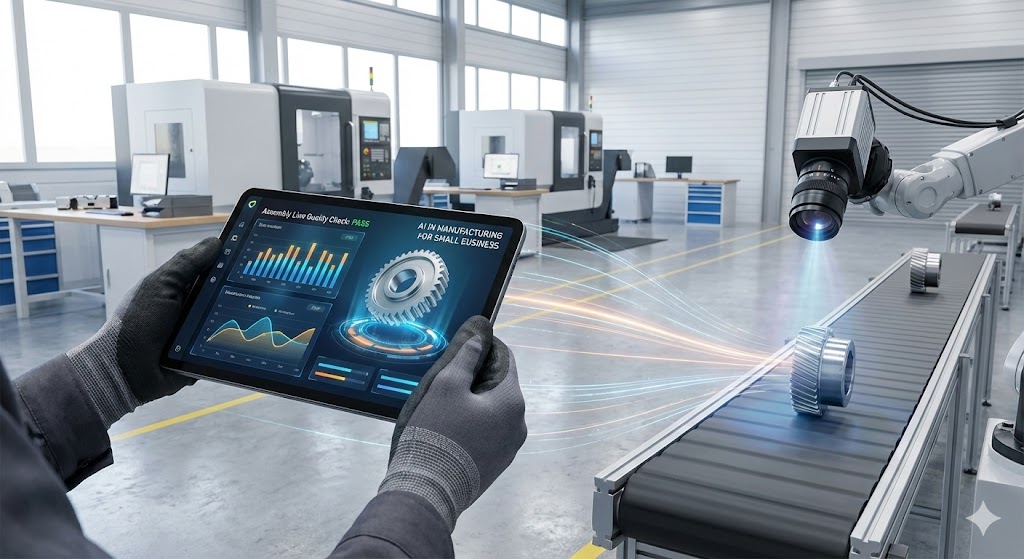
- Real-time Defect Detection: Using high-speed cameras and “Computer Vision,” AI in Manufacturing for Small Business scans every single item on the assembly line. It identifies microscopic cracks, color inconsistencies, or measurement errors in milliseconds.
- Massive Reduction in Waste: By catching errors at the very beginning of the “route,” AI in Manufacturing for Small Business prevents the waste of raw materials on defective products.
- Outbound Link Otoritas: Learn about the impact of AI on manufacturing quality at the ASQ (American Society for Quality).
Route 3: Seamless Generative Design and Rapid Prototyping
AI in Manufacturing for Small Business allows you to design products that were previously impossible to imagine.
- Generative Design Algorithms: You provide the AI with the required strength, weight, and material constraints, and AI in Manufacturing for Small Business generates hundreds of optimized design variations. These designs are often lighter, stronger, and cheaper to produce than anything a human engineer could design manually.
- Accelerated Time-to-Market: What used to take months of prototyping now takes days. AI in Manufacturing for Small Business simulates the manufacturing process in a “digital twin” environment, allowing you to find and fix production issues before you ever cut a single piece of metal.
- Outbound Link Otoritas: Explore the future of generative design at Autodesk.
The Financial Impact: Precision Profitability
Small manufacturers often worry about the “high tech” cost. However, AI in Manufacturing for Small Business actually lowers the barrier to entry:
- Energy Efficiency: AI optimizes machine usage patterns to reduce peak energy demand, saving firms up to 15% on monthly utility bills.
- Scalable Labor: With AI in Manufacturing for Small Business, your current team can produce 3x the output without increasing their hours, leading to massive margin growth.
- Inventory Synergy: By connecting your production floor to our guide on AI in Supply Chain Management, you ensure you never over-order raw materials.
A 30-Day Blueprint for Small Factory Automation
To achieve a Massive production gain, follow this structured four-week route:
Week 1: The Connectivity Audit Before you can use AI in Manufacturing for Small Business, your machines need to “talk.” Identify which legacy machines can be retrofitted with IoT sensors. This “Data Foundation” is the brain of your future smart factory.
Week 2: Pilot Quality Control Implement a single computer vision station at the end of your most critical production line. Let the AI in Manufacturing for Small Business run alongside your human inspectors. You will likely see an incredible jump in catch-rates for defects within the first 7 days.
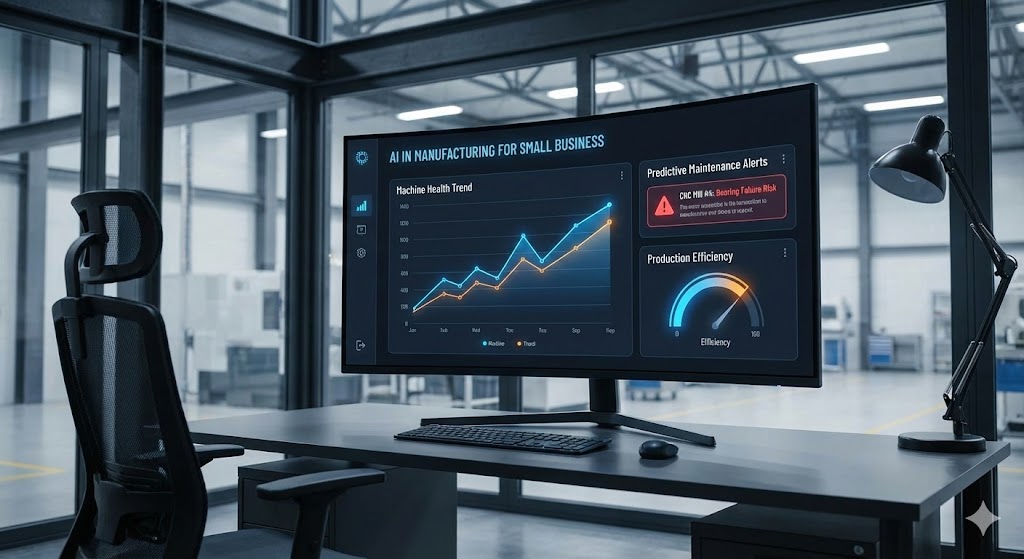
Week 3: Predictive Maintenance Launch Connect your most expensive piece of equipment to an AI monitoring platform. Use AI in Manufacturing for Small Business to establish a “baseline” of normal operation. This will be your early warning system against catastrophic failure.
Week 4: Scaling and Synergy Once you have proven the ROI, expand the AI in Manufacturing for Small Business strategy to your entire floor. Integrate it with your AI for Accounting Firms to automatically track cost-per-unit in real-time.
Conclusion: The Future of the Agile Manufacturer
The implementation of AI in Manufacturing for Small Business is not just about robots; it is about intelligence. By automating the handlers’ work of monitoring and inspection, you free your team to be the master craftsmen and strategic innovators that define your brand.
While other small factories are still struggling with manual waste and unexpected downtime, you will be operating an incredible, powerful, and massive production machine. The route to legendary manufacturing is now automated. We invite you to explore our About Us page to learn more about our mission. For a broader look at business-wide strategy, don’t miss our AI Automation for Small Business guide.